Tablet Press Guide: Working Principle, Common Faults, Maintenance, and Selection Tips – From a Professional Manufacturer
How Does a Tablet Press Work? – How Is a Tablet Made?
A comprehensive guide to the tablet compression process, from powder to finished tablet
Introduction
If you work in pharmaceutical manufacturing, nutraceutical production, or any industry that involves powder compression, you've likely seen a tablet press in action. But have you ever wondered what actually happens inside the machine during that split second when powder turns into a solid tablet?
Understanding the tablet press working principle is not just academic knowledge—it directly impacts product quality, production efficiency, and equipment longevity. In this article, we'll take you through the complete tablet compression cycle, step by step, explaining the role of each critical component along the way.
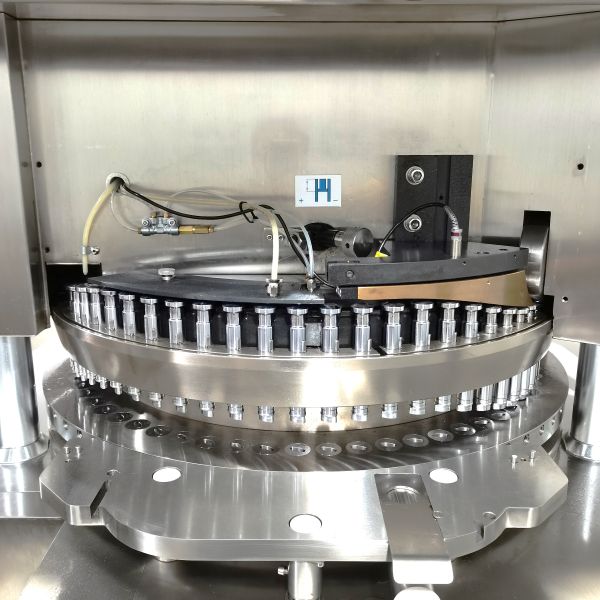
The Basic Concept: What Is a Tablet Press?
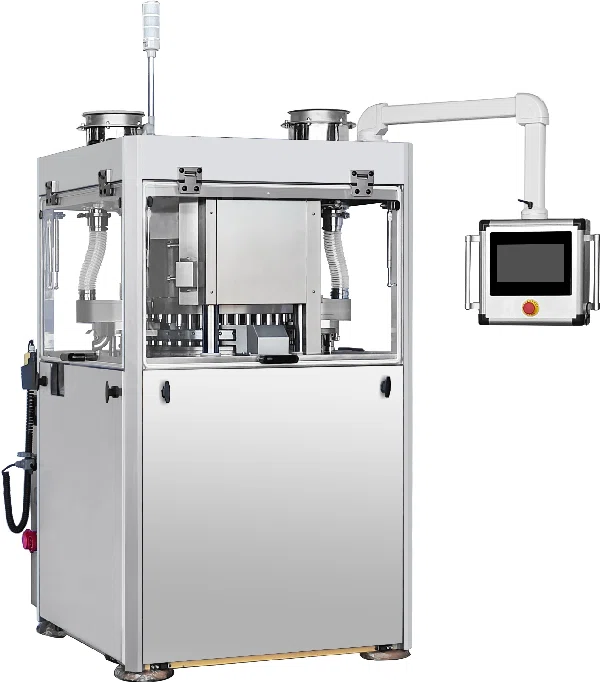
A tablet press (also known as a tableting machine or compression machine) is a mechanical device that compresses powdered or granular materials into uniform tablets of specific size, shape, weight, and hardness.
Tablet presses come in various configurations, but the most common types are:
Single-punch tablet presses (eccentric presses) – used primarily in R&D and small-batch production
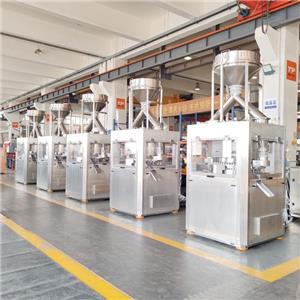
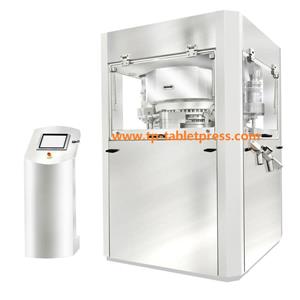
Rotary tablet presses – used in high-volume commercial production, with multiple stations rotating on a turret
Regardless of the type, all tablet presses operate on the same fundamental principle: filling a die cavity with material, compressing it between two punches, and ejecting the finished tablet.
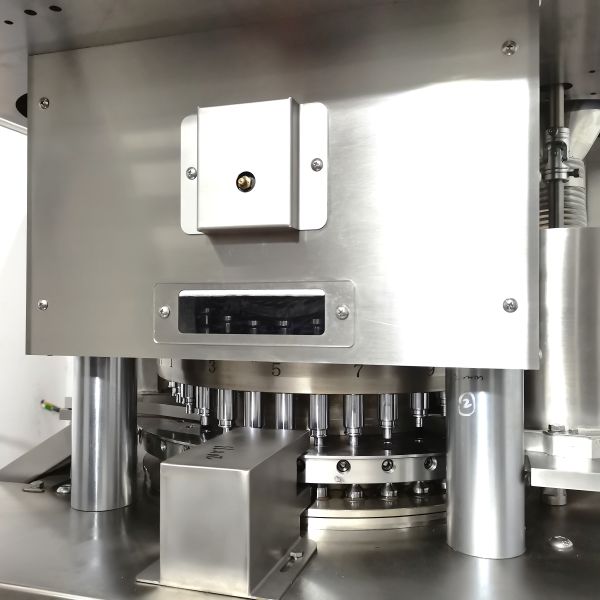
The Tablet Compression Cycle: Step by Step
The tablet-making process is a continuous, high-speed cycle that repeats several times per minute (or per second, in the case of high-speed rotary presses). Here's what happens in each complete cycle:
Step 1: Die Filling
The process begins with the die table (or turret) rotating to position an empty die beneath the feed frame (or hopper).
The lower punch is already positioned inside the die, sealing the bottom of the cavity.
The feed frame (or gravity hopper) delivers granulated powder or blended material into the die cavity.
The amount of material that enters the die is determined by the fill depth—the distance the lower punch is pulled down below the die surface. This depth directly controls the tablet weight.
Key components involved: Die, lower punch, feed frame/fill cam, hopper
Step 2: Dosing / Weight Adjustment
Once the die cavity is filled, the lower punch moves upward to push excess material out of the die. A scraper or wiper blade removes the excess powder from the die table surface, ensuring that each die contains a precise, consistent volume of material.
The fill depth can be adjusted manually or automatically (in modern presses with automatic weight control systems) to maintain consistent tablet weight within tight tolerances.
Key components involved: Scraper blade, fill cam, lower punch adjustment mechanism
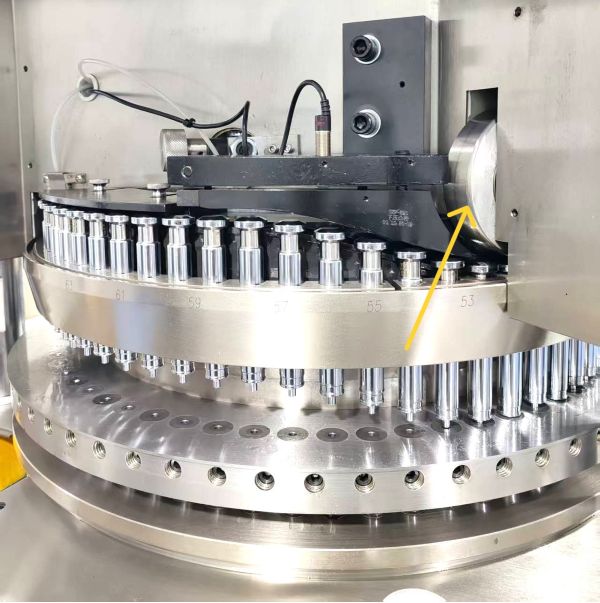
Step 3: Pre-Compression (Optional but Common)
In many modern tablet presses, especially high-speed rotary models, the filled material undergoes a pre-compression stage before the main compression.
A pre-compression roller applies a light, initial pressure to the material.
This serves two important purposes:
Expels trapped air from the powder bed, preventing capping or lamination
Improves content uniformity by gently consolidating the material
Not all presses have pre-compression; single-punch presses typically skip this step and go directly to main compression.
Key components involved: Pre-compression roller, pre-compression cam
Step 4: Main Compression
This is the heart of the tablet compression process—where powder becomes a solid tablet.
As the turret continues to rotate, the upper punch descends into the die cavity while the lower punch is pushed upward by the main compression roller.
The two punches approach each other, compressing the material between them with a controlled amount of compression force (measured in kilonewtons, or kN).
The applied pressure forces the powder particles to bond together through mechanical interlocking and, in some cases, cold welding or fusion (depending on material properties).
The tablet hardness and thickness are determined by:
The compression force applied
The distance between the upper and lower punches at the point of maximum compression
This stage must be precisely controlled. Too little pressure results in soft or friable tablets; too much pressure can cause capping, lamination, or excessive tooling wear.
Key components involved: Upper punch, main compression roller, compression cam, pressure adjustment mechanism
Step 5: Tablet Ejection
After compression, the tablet is now a solid, finished product—but it's still trapped inside the die cavity.
The upper punch is lifted by the upper punch lifting cam, clearing the die.
The lower punch is pushed further upward by the ejection cam, raising the tablet to the die table surface (or slightly above it).
A stationary take-off blade (or scraper) sweeps the tablet off the die table and into a collection chute or conveyor.
At this point, the tablet is ready for downstream processes such as coating, inspection, or packaging.
Key components involved: Upper punch lifting cam, ejection cam, take-off blade, collection system
Step 6: Reset / Return Stroke
The final step returns all components to their starting positions, ready for the next cycle:
The lower punch retracts into the die, resetting the fill depth for the next filling operation.
The turret rotates to the next station, and the cycle repeats.
This entire sequence—filling, dosing, pre-compression (if equipped), main compression, ejection, and reset—occurs in a fraction of a second on high-speed rotary presses, with some machines producing over 500,000 tablets per hour.
Key components involved: Lower punch return cam, turret drive mechanism
Critical Technical Parameters in Tablet Compression
To fully understand how a tablet press works, it's important to be familiar with the key parameters that operators and technicians monitor:
| Parameter | Description | Impact on Tablet Quality |
|---|---|---|
| Fill depth | Distance the lower punch is pulled down | Determines tablet weight |
| Compression force | Pressure applied by the main compression roller | Affects hardness, thickness, and dissolution |
| Pre-compression force | Initial pressure applied (if equipped) | Reduces air entrapment, improves uniformity |
| Turret speed | Rotation speed of the die table | Affects dwell time and production rate |
| Punch penetration | How far the upper punch enters the die | Influences compression profile and tooling wear |
| Ejection force | Force required to push the tablet out | Indicates sticking or poor lubrication |
The Role of Tooling: Punches and Dies
The punches and dies are often referred to as the "heart" of the tablet press. Their condition directly determines tablet quality.
Upper punch: Descends into the die to compress the material from above
Lower punch: Forms the bottom of the die cavity and ejects the finished tablet
Die: The cylindrical cavity that holds the material during compression
Common tooling issues:
Worn punch tips cause weight variation
Damaged die bores cause sticking or binding
Poorly lubricated tooling increases friction and wear
Regular inspection and preventive maintenance of punches and dies are essential for consistent tablet production.
Why Understanding the Working Principle Matters
For operators, maintenance technicians, and production managers, knowing how a tablet press works is not just theoretical—it has practical, day-to-day benefits:
Faster troubleshooting: When a problem occurs (e.g., weight drift, capping, or excessive wear), understanding the process helps pinpoint the root cause quickly.
Better maintenance decisions: Knowing which components handle the most stress (e.g., compression rollers, cam tracks) allows for targeted preventive maintenance.
Improved product quality: Operators who understand the compression cycle can make informed adjustments to fill depth, pressure, and speed to maintain consistent tablet quality.
Reduced downtime: Early detection of abnormal wear or performance issues prevents costly breakdowns.
Common Questions About Tablet Press Operation
Q: What causes tablet weight variation?
Weight variation is typically caused by inconsistent fill depth, worn lower punches, poor powder flowability, or erratic turret speed.
Q: Why do tablets sometimes stick to the punch faces?
Sticking is often due to excessive moisture in the granulation, insufficient lubrication, or worn/rough punch surfaces.
Q: How do I know when to replace tooling?
Replace punches and dies when wear exceeds acceptable limits—indicated by weight drift, loss of tablet hardness, or visible scoring on tooling surfaces.
Conclusion
The tablet compression process is a remarkable feat of mechanical engineering—transforming loose powder into a precise, uniform tablet in milliseconds. From the initial fill to the final ejection, every step is orchestrated by carefully designed cams, rollers, and punches working in perfect synchronization.
Whether you're operating a single-punch press in a laboratory or a high-speed rotary press in a large-scale manufacturing facility, a solid grasp of the tablet press working principle is the foundation of quality production and efficient equipment management.
About the Author
This article is brought to you by Shanghai Tablet Press Mechanical Components Co., Ltd. — a professional manufacturer specializing in various types of tablet presses, with over 240 employees and decades of industry experience. We are committed to sharing practical knowledge to help our customers optimize their tablet production processes.
Has your tablet press encountered any issues during operation? Feel free to leave a comment or contact us—we're happy to provide expert guidance.
Keywords: tablet press working principle, how does a tablet press work, tablet compression process, rotary tablet press operation, powder compaction machine, pharmaceutical tablet press, tablet making process, punch and die tooling.